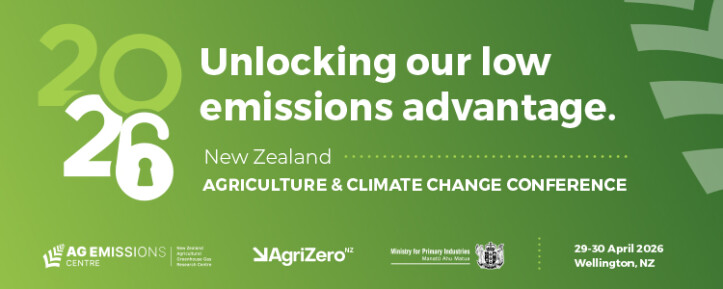
New Zealand Agriculture & Climate Change Conference 2026

Published: April 1, 2026

Tagged with:

  • Events
  • News


About the Conference

The 2026 New Zealand Agriculture & Climate Change Conference is on 29-30 April 2026 and will be held at Tākina Events in Wellington, New Zealand.

Unlocking Our Low Emissions Advantage

Global food markets are evolving. Low-emissions production is emerging not just as a sustainability requirement, but as a defining marker of quality, resilience, and long-term value.

The 2026 Agriculture and Climate Change Conference is brought to you by the Ag Emissions Centre in partnership with AgriZero and MPI. The event brings together international market leaders, policymakers, rural professionals, scientists, and farmers to examine what these changes mean for New Zealand and how the country can respond strategically.
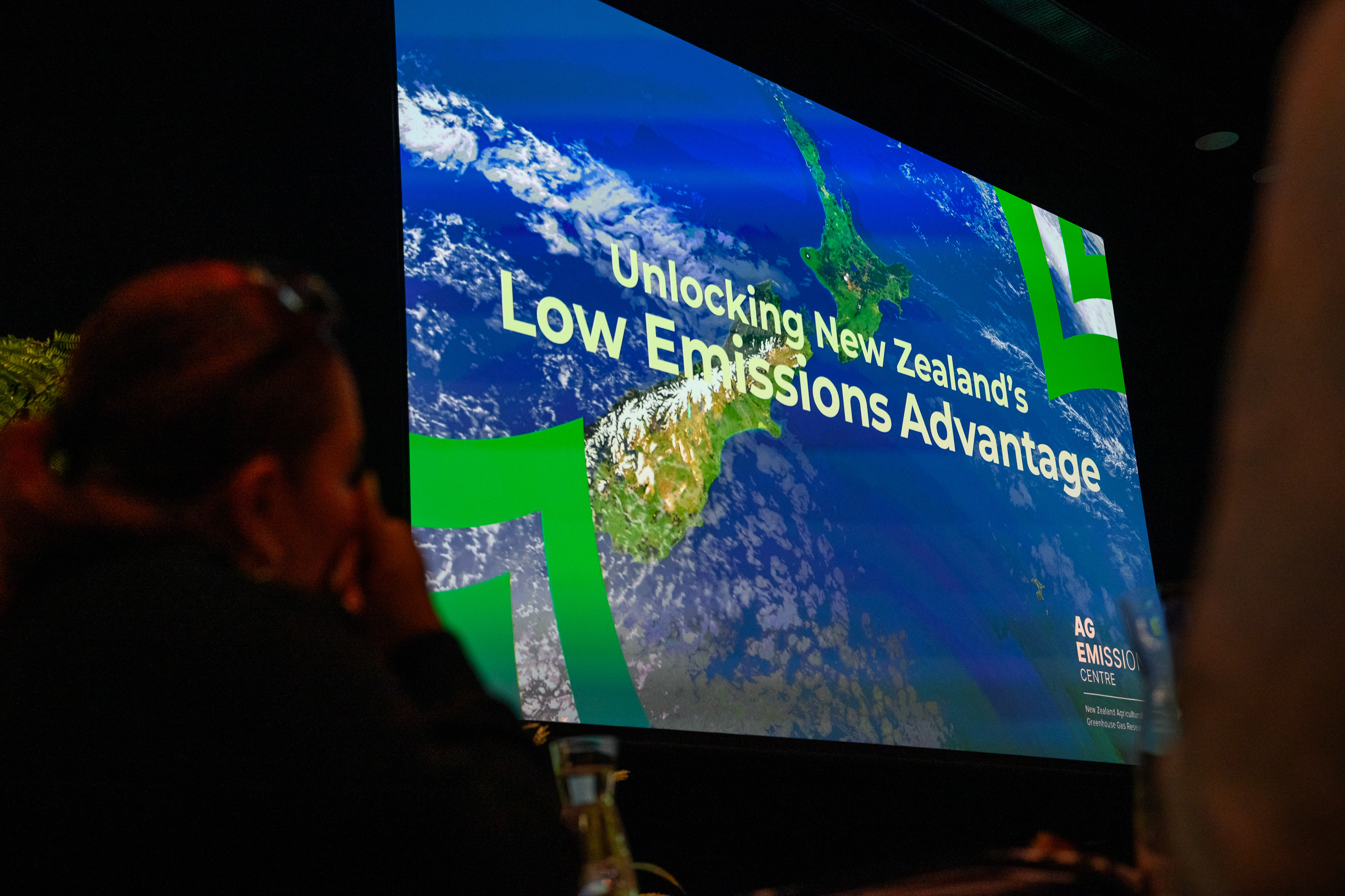
Speakers include Hon. Todd McClay, with our emcee Climate and Energy Communicator Eloise Gibson guiding the conversation across both days. Alexander Hillary will deliver an aspirational talk to inspire and challenge attendees. The evening dinner on 29 April will feature guest speaker Oliver Hunt, with Mark Piper as emcee.


Additional Conference Features

  • All plenary sessions will be live-streamed, with recordings available to online and in-person delegates
  • Networking and Q&A opportunities built into the programme
  • Optional conference dinner celebrating innovation in low-emissions agriculture.


Speaker Highlights

Eloise Gibson

A climate and energy communicator, Eloise Gibson is an award-winning journalist who has spent her career reporting on climate change, science and the economy. She was New Zealand’s first Climate Change Correspondent at RNZ, the country’s first dedicated Climate Change Editor at Stuff, and the inaugural science and environment editor at Newsroom. Her work has earned multiple Voyager Media Awards, including Business Reporter of the Year, Environmental Journalist of the Year and Science Journalist of the Year, as well as recognition for reporting on ethical finance.

Eloise’s reporting has appeared internationally in outlets such as BBC Future, BBC Earth and Bloomberg Businessweek. A Fulbright scholar with a Master’s in Science Journalism from Columbia University, she brings deep subject knowledge and a strong grounding in evidence.

She offers a clear, independent perspective on how climate and agricultural issues are interpreted by the public; and on how to communicate complex science in a way that is both clear and trusted.

Alexander Hillary

Alexander Hillary is General Manager of the Himalayan Trust and grandson of legendary mountaineer Edmund Hillary. Through his work, he continues a family legacy built on exploration, resilience, and practical problem-solving in some of the world’s most challenging environments.

Hillary has spent much of his life in remote landscapes, from New Zealand’s high country to the polar regions, developing a deep appreciation for the people and communities who live and work closely with the land. In his role with the Himalayan Trust, he supports long-standing development work in Nepal, helping strengthen education, health, and community resilience across Himalayan communities.

He is also a patron of Hillary Outdoors, helping inspire young New Zealanders to build confidence, leadership, and environmental awareness through outdoor education. Alexander is also an Inspiring Explorer with the Antarctic Heritage Trust.

Drawing on these experiences, Alex speaks about leadership, responsibility and the discipline required to pursue ambitious goals. He brings an aspirational yet grounded perspective on perseverance, stewardship and the role individuals and communities play in shaping a positive future.

Oliver Hunt

Oliver Hunt is the founder of Medsalv, a Christchurch-based company pioneering the remanufacture and safe reuse of medical devices previously treated as single-use. Trained as an engineer at the University of Canterbury, Hunt developed the idea while completing his master’s degree after recognising that many medical products were being discarded despite having the potential for safe reuse.

He began with a single device, thrombosis prevention sleeves, developing a process to inspect, clean, test and remanufacture them for multiple uses. Today, Medsalv applies this approach to more than 50 different medical products, working with nearly 170 hospitals across New Zealand and Australia, with facilities in both countries. The model reduces waste, lowers costs for healthcare providers, and creates local employment opportunities, including roles for people who face barriers to work.

Hunt’s work demonstrates how practical innovation and circular thinking can deliver measurable environmental and economic benefits. He will share insights on turning complex waste challenges in large scale systems into scalable, real-world solutions.

Sue Bidrose

Dr Sue Bidrose is an experienced science and public sector leader who has held senior roles across research, government and local administration. She is the former Chief Executive of AgResearch and previously served as Chief Executive of the Dunedin City Council, where she led a large and complex public organisation through a period of significant change.

Bidrose began her career as a laboratory technician working on metabolic diseases in dairy cattle before moving into leadership roles spanning central government, science organisations and the not-for-profit sector. She has also served as Chair of Science New Zealand and held a range of governance positions across health, research and public service organisations.

With a PhD in psychology and extensive experience navigating the science system, policy environment and public accountability, Bidrose brings a thoughtful and balanced perspective to complex issues. As host for the conference dinner, she will guide the conversation and help connect diverse perspectives from across science, industry and innovation.

Session One Setting the Scene: the Economic Environment

Julie Collins

Julie has more than 30 years’ experience in primary industries and resource use policy here and in the UK. She has led senior roles in climate change, the Emissions Trading Scheme, forestry, biosecurity, animal welfare and food policy. Recently she led Te Uru Rākau, a new MPI branch, and has also worked in the food safety standards area.

Over the years, she has worked in the New Zealand Forest Service, the Ministry of Forestry and the Ministry of Agriculture and Forestry. Julie also spent 15 years in the UK, working for the UK Government on Community Forestry, Common Agriculture Policy Reform and Rural Development initiatives.


Cameron Bagrie

Cameron Bagrie is Managing Director of Bagrie Economics, an independent research consultancy known for clear, practical advice grounded in data. With more than 20 years’ experience in financial markets and public policy, he previously served as Chief Economist at ANZ, and held senior roles at the National Bank, the Treasury and Statistics New Zealand.

Cameron specialises in translating global economic and investment trends into tangible business risk and opportunity. He is widely respected for cutting through noise and identifying the structural shifts that influence capital flows, sector performance and long-term competitiveness.

Cameron will unpack why current global shifts are real, durable and already reshaping investment decisions, and what that means for agriculture, innovation and the practical choices leaders need to make now.


Jo Hendy

Jo Hendy is Chief Executive of New Zealand’s Climate Change Commission, where she leads independent, evidence-based advice on reducing emissions and strengthening resilience. With more than two decades’ experience across science, economics and public policy, she is known for clear thinking and steady leadership in complex, high-stakes environments.

Jo has built her career at the intersection of research and decision-making, helping governments and stakeholders translate long-term climate goals into practical, durable policy. She works closely with business, iwi and communities to ensure advice is grounded in real-world constraints and opportunities, and that it earns public trust.

Jo brings a national perspective on climate strategy, implementation and the role of credible, independent advice in guiding practical progress.

Session Two: Global Market Signals & Customer Expectations

Zhu Zhiping

Dr. Zhiping Zhu is a Professor at the Institute of Environment and Sustainable Development in Agriculture, Chinese Academy of Agricultural Sciences (CAAS) in Beijing, China. He earned his Ph.D. in Agricultural Bio-environmental Engineering from China Agricultural University in 2007. His research expertise focuses on livestock manure management, with a specific emphasis on quantifying and mitigating greenhouse gas (GHG) and ammonia emissions from livestock production systems.

Dr. Zhu has led numerous high-impact national research projects as Principal Investigator (PI), including programs under the National Key R&D Program of China and the Natural Science Foundation, investigating emission reduction technologies and pollution source coefficients, he has also been involved in the national greenhouse gases inventory of China's animal husbandry. As a key contributor in this field, he has won the Second Prize of the National Science and Technology Progress Award of China twice (in 2012 and 2018). He has published extensively in leading journals, including Nature Food, where his work explores integrated mitigation strategies for livestock pollution. Dr. Zhu's research provides a critical scientific foundation for developing sustainable agricultural practices and informing environmental policy in China.


Matthias Hess

Professor Matthias Hess teaches biochemistry and microbiology at the University of California, Davis, in the United States, where he also leads a successful research program in systems microbiology and natural product discovery. Dr. Hess is a microbiologist who has driven advances in rumen microbiology and microbial ecology for over two decades. His research combines traditional microbiology with advanced in silico and in vitro methods to uncover how rumen microbes convert recalcitrant plant biomass into metabolites usable by the host. He pioneered multi-omics applications in the rumen, and his team was the first to assemble genomes from previously uncultured microbes, laying the groundwork for understanding carbon and hydrogen flux in this ecologically and economically important ecosystem. At UC Davis, his group has developed advanced artificial rumen systems for high-throughput screening of feed additives, enabling strategies that redirect feed energy away from methane and other waste products toward value-added metabolites, thereby improving livestock productivity and environmental sustainability.


Charmaine Dhalwanth

Charmaine Dhalwanth is a Sustainability Senior Manager at Danone, based in Auckland, New Zealand. She leads the company’s regional sustainability strategy, translating global commitments into practical action across supply chains, operations, and product systems.

With more than 20 years’ experience across the food and beverage sector, Charmaine has held roles with PepsiCo, Cipla and Tigerbrands, working across Sub Saharan Africa and the APAC region. Her background spans manufacturing, supply chain, food safety, quality systems, and extended producer responsibility, giving her a strong understanding of how sustainability requirements are implemented in practice.

Charmaine’s work focuses on aligning commercial priorities with measurable environmental outcomes, particularly in response to evolving customer and market expectations. She brings a global customer perspective on how procurement is shifting toward lower-emissions products, and what these signals mean for New Zealand producers.


Lachlan Monsbourgh

Lachlan Monsbourgh is Rabobank’s Australian-based Global Rural Agricultural and Environmental Lead, working with more than 15,000 rural enterprises worldwide. In his role at Rabobank, he oversees initiatives to measure Scope 3 emissions and nature-related data and contributes to the development of global sustainability policy and industry standards.

With more than two decades of experience across agricultural systems in Australia, Asia, Africa and Latin America, Lachlan has worked from plantation management and agribusiness operations through to sustainability frameworks and carbon market strategy. He combines on-the-ground commercial experience with a clear understanding of how environmental performance is increasingly shaping capital, supply chains and market access.

Lachlan is recognised for his pragmatic approach and brings a global banking and market lens to how emissions measurement, data, and environmental performance are shaping farming’s future competitiveness.


Charlotte Rutherford

Charlotte Rutherford is Director of Sustainability at Fonterra Co-operative Group, where she leads the design and delivery of the co-operative’s sustainability strategy. With more than 20 years’ experience in the dairy sector, she has played a central role in integrating environmental performance into core business strategy, from on-farm practice through to global markets.

Charlotte has overseen the development of Fonterra’s Climate Roadmap and its 2030 targets, verified by the Science Based Targets initiative, and works closely with farmers, customers and regulators to ensure progress is measurable and commercially grounded. Her focus is on creating value from New Zealand’s dairying credentials while supporting long-term resilience and performance.

Charlotte will share a processor’s perspective on connecting farm-level action with market expectations, and what it takes to embed practical emissions reduction into a global supply chain.


Carolyn Mortland

Carolyn Mortland is Executive Officer – Sustainability at Zespri, where she works with the global kiwifruit industry to strengthen its environmental performance while supporting continued export growth. Her role focuses on helping the sector respond to evolving customer expectations, manage climate-related risks, and build credible sustainability practices across the supply chain.

Ms Mortland has over 15 years’ experience advising organisations on climate strategy, sustainability, and stakeholder engagement. She previously led sustainability at Fonterra, during which time Fonterra published its first audited sustainability report, set ambitious climate targets, established a net zero research farm and implemented a farm incentive programme to reward environmental and social best practice.

Ms Mortland is a member of the XRB’s Sustainability Reporting Board, has served on sustainability advisory panels for Zespri and Pāmu, and provided advice to primary sector exporters as a NZTE Beachheads Advisor. In this session, she will share insights on aligning sustainability, market access, and long-term value in global food systems.

Session Three: Low-Emissions Agriculture Research: International Insights

Richard Heath

Richard Health is the Chief Executive Officer of Zero Net Emissions Agriculture Cooperative Research Centre - a national collaboration bringing together 70 partners across industry, government, and researchers - to reduce emissions from Australian agriculture.

His extensive experience in the Australian agriculture sector extends across multiple high-profile roles including as Executive Director with the Australian Farm Institute, Associate Professor of Agronomy and Farm Management at the University of Sydney and Nuffield Australia Farming Scholar. Richard is also a non-executive director of the Grains Research and Development Corporation.

Under his current leadership, the CRC is developing standardised metrics, guidelines, and benchmarking tools to support credible on-farm emissions measurement and informed decision-making. Richard will share insights from Australia’s journey, including how collaboration, science and market realities are shaping the path forward for low-emissions farming.


Peter Lund

Peter Lund obtained his PhD from The Royal Veterinary and Agricultural University, Copenhagen, Denmark, and is currently Head of the Ruminant Nutrition section and professor in Sustainable Dairy Production at Aarhus University, Denmark, a position which is in collaboration with Arla. The research scope is the development of new technologies that can promote the green transition of agriculture and the development of a more sustainable livestock production with a key interest in inter-disciplinarily, i.e., the interplay between feed production, nutrition, rumen microbiome, genetics, and product quality. His research area is ruminant nutrition with emphasis on feed additives and feeding strategies that can facilitate significant reductions in enteric methane. A key research area has been the use of Bovaer in a Danish setting and quantification of reduction potential and potential side-effects. He collaborates with different stakeholders such as Arla, Nestle, Danish Crown, Novozymes, and DSM. He gives advice to public authorities on the climate and environmental impact of cattle production with special emphasis on feeding strategies to reduce enteric methane, and inclusion of such strategies in the national inventory system. He is the Danish representative in the Global Research Alliance on Agricultural Greenhouse Gases (GRA Livestock) and in the adjacent Feed and Nutrition Network. He will share insights from European research and the role of nutrition-based solutions in reducing livestock methane emissions.


Session Four Leading at Home: How NZ farmers are responding to low‑emissions demand

Carla Muller

Carla is a principal consultant and director at Perrin Ag, where she specialises in agricultural economics. She has worked on projects across dairy, sheep and beef and horticulture and lives on a sheep and beef farm in the Bay of Plenty with her partner and family. She has also had a range of governance roles across the primary sector and has seen both challenges and opportunities from grassroots through to the board level.


Paul McGill

Paul McGill is Head of Innovation and Extension at Pāmu, bringing an applied farming lens to innovation and system change. He has ten years’ farm management experience across dairy, livestock, and arable systems, including winning the Wairarapa Farm Business of the Year in 2006.

A New Zealand Nuffield Scholar (2010), Paul has combined global exposure with recent Massey University qualifications in greenhouse gas and sustainable nutrient management, strengthening his focus on solutions that work in real farm settings.

Paul now leads programmes that connect research partnerships with innovation adopted at scale across Pāmu’s farm operations. His work spans agronomy, dairy‑beef integration, genetics, and pastoral performance, with a strong focus on productivity, market value, and resilience. He works closely with farmers and industry partners to test what works, share learnings, and lift capability across the wider sector.


Hinehou Timutimu

Hinehou Timutimu (Tūhoe, Whakatōhea, Te Ātiawa) is the General Manager of Te Tawa Kaiti Lands Trust in Ruatoki, Bay of Plenty, working alongside whānau, hapū, iwi and partners across an integrated whenua‑based enterprise combining dairy farming and maize production.

Hinehou leads Project Te Aroha, which includes two key streams. Whenua Ora, supported through the Climate Emergency Response Fund (CERF) and MAPIP, focuses on land‑use optimisation and improving farm system performance. Alongside this, He Whāriki mō Paekoau is a community‑led, catchment‑scale programme supporting freshwater health and biodiversity through restoration and environmental monitoring, including freshwater eDNA testing. Her work reflects a values‑led, intergenerational approach often described as “Pakeke Fed, Mokopuna Led”.

She is responsible for He Ara ō ngā Mātātā – He Ara Whakaoranga, a wetland restoration project supporting at‑risk species. Hinehou is Deputy Chair of the Ballance Farm Environment Awards Management Committee and a Kellogg Rural Leadership Programme Scholar for 2026.


Ka ora ai te Whenua, Ka ora ai te Tangata
      When we care for Papatūānuku, our People will Prosper

Session Five: The role of tools and technology to unlock our low emissions advantage

John Roche

Dr John Roche is a globally recognised expert in agricultural science and was appointed Chief Science Advisor to New Zealand Prime Minister Christopher Luxon in May 2025.

He also serves as Deputy Chair of the Prime Minister’s Science and Technology Advisory Council, which was established to guide the government on key scientific priorities and challenges.

Dr Roche grew up on a dairy farm in Castleisland, Ireland, where his early experiences shaped his passion for agricultural innovation and sustainability. He holds an Honours degree in Animal Science, a Master’s in Farm Systems and Pasture Management, and a PhD in Animal Nutrition. His academic and professional career spans Ireland, Australia, and New Zealand, with a focus on advancing sustainable farming practices and improving agricultural productivity.

Dr Roche has also served as Chief Science Adviser at the Ministry for Primary Industries (MPI) since 2018, a role he continues on a part time basis. At MPI, he led the organisation’s science forum, chaired the science governance group, and oversaw the independent Mycoplasma bovis Strategic Science Advisory Group. He also contributed to the Prime Minister’s Chief Science Advisor’s Forum and held an adjunct professorship at the University of Auckland’s School of Biological Sciences.

Dr Roche’s previous roles include Principal Scientist for Animal Science at DairyNZ, where he worked on innovative solutions to enhance the dairy sector’s sustainability and resilience. His expertise in animal nutrition, farm systems, and pasture management has made him a trusted advisor in both scientific and policy circles.


Brendan O'Connell

Brendan O’Connell is Chief Executive of AgriTech New Zealand, the industry body connecting innovators, researchers, investors and policymakers working to advance agricultural technology. He leads the organisation’s work to strengthen New Zealand’s agritech ecosystem and support the development and adoption of technologies that improve farm productivity and environmental performance.

O’Connell trained as a mechanical engineer and has built an international career spanning product innovation, business development and technology commercialisation across sectors including biomedical devices, telecommunications and agritech. Before joining AgriTech New Zealand, he held senior roles at Tru-Test Group, where he helped shape the company’s growth strategy and identify new technology opportunities for the livestock sector.

With a global perspective and a strong background in innovation-led businesses, O’Connell focuses on how technology can help agriculture respond to evolving environmental, market and productivity challenges. He will share insights on the role of agritech in enabling practical, scalable solutions for farmers.


Melissa Clark-Reynolds

Melissa Clark-Reynolds is a futurist and technology entrepreneur who works with leaders to make sense of rapid change and turn emerging trends into practical strategy. Trained by the Institute for the Future and appointed an Officer of the New Zealand Order of Merit for services to the technology industry, she brings both global perspective and hands-on business experience.

Melissa has advised organisations ranging from Spark and IAG to NASA and Australian Pork, helping them navigate digital disruption, risk, and long-term transformation. She is known for cutting through hype, asking hard questions and providing clear frameworks that support better decisions.

In a sector facing accelerating advances in artificial intelligence, Melissa offers a grounded view of what is real, what is coming, and what matters most. She will unpack what the rise of AI means for agriculture and outline what leaders should be acting on now to stay ahead and accountable.

Session Six R&D portfolio update: progress across New Zealand’s methane tools and technologies.

Naomi Parker

Naomi is passionate about science for outcomes, evidence-based policy and decision-making, supporting Treaty partnership, and the sustainable use of natural resources.

Naomi joined the AgEC as Executive Director in October 2023. She has held a range of roles at the Ministry for Primary Industries at the science policy interface ranging from technical leadership in marine biosecurity, to heading up science and skills policy functions, and leading the establishment of the Centre for Climate Action on Agricultural Emissions. 

Naomi thrives on leading multi-disciplinary teams and working through difficult issues with stakeholders from diverse backgrounds to get the best outcomes.

Naomi’s science background is in ecology with a focus on algal bloom dynamics. She has a PhD from the University of Tasmania, an MSc from the University of Tennessee, Knoxville, a graduate diploma in Antarctic and Southern Ocean Studies with honours also from the University of Tasmania and a BSc from Flinders University of South Australia.


Wayne McNee

Wayne McNee, Chief Executive, AgriZeroNZ, specialises in leadership, strategy, and sustainability across the agribusiness and health sectors. He is the former Chief Executive/Director General of PHARMAC, the Ministry of Fisheries, the Ministry of Agriculture and Forestry, the Ministry for Primary Industries, and the Livestock Improvement Corporation (LIC). Wayne completed a Pharmacy Degree and post graduate study at the University of Otago, and has studied leadership, strategy and business transformation at Oxford, Stanford, Insead, and IMD business schools. He was appointed as Chief Executive of AgriZeroNZ in October 2023, after being instrumental in setting up the world-first public-private partnership and supporting its establishment (1 February 2023) as interim executive director.


Lewis Frost

Lewis, Head of Growth and Marketing at Nbryo, has a comprehensive professional background spanning remote animal monitoring, livestock genomics, animal health and molecular diagnostics. Lewis has a Bachelor of Science with Honours from James Cook University, a Master of Business Administration from the University of Queensland and is a graduate of the Australian Institute of Company Directors.

Throughout his career, Lewis has focused on enabling the adoption, extension, and commercialization of innovative technologies in production animal industries, from startups to multinational enterprises. Notably, he has achieved significant growth in animal monitoring, launched world-first genomic and smart monitoring products, and driven commercial expansion across global markets.

Since joining Nbryo in January 2023, Lewis has led the charge on commercial activation and strategic growth.


Andrew Leech

Dr Andrew Leech is Chief Executive of Bovotica, an Australian agritech company developing probiotic solutions designed to reduce methane emissions from cattle while improving animal performance. Bovotica’s mission is to apply advances in microbiology to influence the microbial communities within the rumen, creating practical tools that can be integrated into livestock production systems.

Bovotica’s research has identified naturally occurring microbes associated with low methane-emitting cattle. The company is developing probiotic products that aim to shift rumen fermentation, reducing methane production while directing more energy toward growth and milk production. Solutions currently in development include a feed additive and longer-acting treatments suited to pasture-based systems.

Leech holds a PhD in biochemistry from the University of Queensland and co-founded Bovotica alongside Prof Gene Tyson and Prof Phil Pope from Queensland University of Technology. He will discuss the potential of microbiome-based approaches to deliver practical methane reduction tools for livestock farmers.


John Caradus

Dr John Caradus is Chief Technology Officer at Grasslanz Technology and one of New Zealand’s most experienced pasture plant breeders. Over several decades he has led research focused on improving forage species to enhance productivity, resilience, and environmental outcomes in pastoral farming systems.

Caradus has played a key role in the development of multiple white clover cultivars widely used in New Zealand pastures as well as commercial delivery of Epichloë endophytes in ryegrass. Earlier in his career he led the Plant Breeding and Genomics Platform at AgResearch and served as Global Programme Leader for the New Zealand dairy industry’s on-farm research programme in forage and feeding.

He holds a PhD from University of Reading and was elected a Fellow of the Royal Society of New Zealand in recognition of his contributions to agricultural science. Caradus will share insights into how advances in plant breeding and forage systems may contribute to lower nitrous oxide emissions from livestock farming.


Jacob Bubolz

Jacob (Jake) Bubolz is a Senior Principal Scientist at Zoetis, where he leads the livestock in vivo translational biology group within Veterinary Medicine Research and Development to advance technologies that improve livestock health, productivity, and sustainability. After earning his M.S. in Animal Science from the University of Florida, he joined Zoetis in 2010 where he has contributed across the vaccine and therapeutic portfolios.

Jake brings discovery to development research experience across cattle and swine, spanning from clinical study conduct to project team leadership.

A lifelong advocate for practical sustainability, Jake grew up on a dairy farm and understands the imperative to reduce methane emissions while maintaining or improving production efficiency. He currently serves as Zoetis’ lead for a collaborative methane inhibition initiative, evaluating how emerging technologies can simultaneously support animal performance and reduce emissions. Jake will share his industry-grounded perspective focused on delivering pragmatic, on-farm solutions for producers.


Richard Spelman

Dr Richard Spelman is Chief Scientist at Livestock Improvement Corporation (LIC), where he leads the organisation’s research and development programmes supporting genetic improvement in the New Zealand dairy herd. A leading geneticist in the dairy sector, he focuses on applying advanced breeding science to improve productivity, resilience and environmental performance on farm.

Spelman joined LIC in 1991 and returned to the organisation after completing a PhD in Animal Breeding and Genetics at Wageningen University, following earlier study at Massey University. Since becoming Chief Scientist in 2012, he has helped drive the use of genomic technologies to accelerate genetic gain and deliver new tools for farmers.

His work includes research into breeding cattle with lower methane emissions, improving heat tolerance through the “slick” gene, and developing new approaches to herd health monitoring. Spelman will share insights into how genetic science is contributing to practical, long-term solutions for lower-emissions dairy systems.


Sinead Leahy

Sinead Leahy is the Principal Scientist at the Ag Emissions Centre. 

Sinead holds a Ph.D. in microbiology and biochemistry and has worked in a variety of research and advisory roles in New Zealand, including as a Senior Research Scientist in the Rumen Microbiology team at AgResearch. At the AgEC, Sinead oversees the development of scientific research programmes and initiatives aimed at reducing greenhouse gas emissions from agricultural activities. Her work includes collaborating with farmers and growers, rural professionals, industry leaders, science, and government agencies to identify and implement innovative solutions to this complex challenge.

Sinead is recognised for her expertise and contributions to the field of agricultural greenhouse gas research science. She is the New Zealand Co-Chair of the Livestock Research Group of the Global Research Alliance on Agricultural Greenhouse Gases; and she is a member of the international Scientific Oversight Committee for the Global Methane Hub Enteric Fermentation R&D Accelerator Program.


George Reeves

George Reeves is Commercial Director at Ruminant BioTech, where he leads market access, regulatory approvals, stakeholder engagement and commercial strategy for new agricultural technologies. His work focuses on bringing practical emissions-reduction solutions to market and supporting their uptake across the livestock sector.

Reeves has more than 30 years’ experience across agriculture, animal and human health, and fast-moving consumer goods in New Zealand, Australia and the United Kingdom. Throughout his career he has held senior leadership roles in multinational organisations, working at the intersection of science, product development and market adoption.

At Ruminant BioTech he is helping guide the commercialisation of a methane-inhibiting bolus for cattle designed to significantly reduce methane emissions for extended periods. His experience navigating regulation, partnerships and market development provides valuable insight into how new technologies move from research to real-world use. Reeves will share perspectives on the challenges and opportunities involved in scaling practical emissions solutions for livestock farming.


Elliot Mercer

Elliot Mercer is General Manager of Agnition, Ravensdown’s innovation and venture arm, where he helps build and invest in agtech ventures that deliver practical solutions for farmers. His work focuses on turning promising ideas and research into commercially viable solutions that can deliver practical value for farmers and the wider agricultural sector. He is a Director of EcoPond Limited, one of Agnition’s portfolio companies, which is developing manure management technology to reduce emissions and improve nutrient management on farm. EcoPond is achieving strong adoption and generating real-world emission reductions on farm.

Elliot also serves on the Boards of Tech New Zealand and AgritechNZ and previously held leadership roles with PwC and Fletcher Building focused on innovation and business transformation.

He will share insights into how new technologies and business models can move from concept to practical tools for farmers.


Mark Neal

Dr Mark Neal is Head of Data Science and Modelling at DairyNZ, where he leads a team focused on analysing farm systems, profitability and environmental performance across New Zealand’s dairy sector. His work combines agricultural economics, data science and farm systems modelling to help farmers and industry understand how different management decisions affect both financial outcomes and emissions.

Mark plays a key role in major collaborative research initiatives, including projects that examine the relationship between emissions and farm profitability. Working with partners such as Fonterra and Livestock Improvement Corporation, these programmes use large datasets and advanced modelling techniques to evaluate practical pathways for lower-emissions dairy systems.

Originally trained as an agricultural economist at the University of Sydney, Mark has combined research with hands-on farming experience in Australia, Chile and the United States. He will share insights into how data and modelling are helping farmers make informed decisions in a changing operating environment.

Registration Details

Dinner is included with the two-day in-person + dinner ticket. 

Morning tea, lunch and afternoon tea is included for in-person delegates.

Access to the Conference App

Please note that accommodation is not included in the registration fee; however, discounted accommodation rates for NZACCC 2026 are listed under the accommodation tab below. Please also be aware that visa support letters are not available for international delegates.

Registration type

Standard Registration

In-person (2 days)

$325.00

In-person (2 days + dinner)

$385.00

In-person (day two only)

$250.00

In-person (day two + dinner)

$320.00

In-person (day one only)

$250.00

In-person (day one + dinner)

$320.00

Online (both days)

$165.00


Accommodation

Delegates can choose from a selection of nearby hotels, all within easy walking distance of Tākina Events, offering convenience, comfort, and exclusive rates for attendees. If you require accommodation simply: 

Click on the link for your preferred hotel to book your stay.

For Oaks Wellington and QT Wellington, please enter the provided discount code during booking to receive the special rate.

Complete your booking directly with the hotel.

🏨 Microtel by Wyndham Wellington | 25 Vivian Street

Walking distance: 11mins (800m)
Book accommodation at Microtel today

🏨 Oaks Wellington | 89 Courtenay Place

Walking distance: 6mins (400m)
Website: Hotels in Wellington New Zealand | Oaks Wellington Hotel Official Site
Discount Code: EVENT15

🏨Ramada by Wyndham Wellington | 123 Taranaki Street

Walking distance: 11mins (700m)
Book accommodation at Ramada today

🏨TRYP by Wyndham Wellington | 15 Tory Street

Walking distance: 4mins (280m) 
Book accommodation at TRYP today

🏨 QT Wellington, Museum Apartment | 90 Cable Street

Walking distance: 2mins (170m)
Website: QT Hotels & Resorts | Luxury Boutique Hotel Accommodation
Discount Code: NZACC26

If you have any questions, please email conference enquiries at enquiry@ag-emissions.nz

Published: April 1, 2026